
- Dating apps
- Meeting people IRL
- Friendship
Social matching: why Rivet swaps the algorithm for your friends
Rivet, launched by a former Tinder executive, lets friends and strangers pick your matches. Here's what this shift to social matching reveals about dating apps.
By Mathis Mauprivez
4 min read
Contents
This week, Bloomberg, the Seattle Times, Mashable and Digital Trends all covered the same launch: Rivet, an app founded by a former Tinder executive that promises to replace the algorithm with human judgement. Its concept, dubbed “social matching”, lets friends or complete strangers vote on the compatibility of two people before they’ve even met. This convergence of coverage says something about a deeper shift: after years of solo swiping, dating seems to be reaching for a social, collective dimension once again.
Rivet, a former Tinder executive’s bet against the swipe
Taru Kapoor spent eight years at Tinder, where she was general manager for several markets, before launching Rivet in the US on 24 September, according to the Seattle Times. To fund the venture, she raised $10 million, reports Inc, a figure her co-founder Rajat Sahni put at $10.5 million in a LinkedIn post, from investors including Peak XV Partners, Shine Capital and Blume Ventures.
Her assessment is blunt: mainstream apps reduced the friction of meeting people, but in stripping it away, they also stripped away the people. “Dating has always been social,” Kapoor said in a press release shared with Mashable. A rare admission from someone who built her career inside the industry.
How “social matching” works
On Rivet, you don’t swipe for yourself. Everyone signs up as a “Dater” (looking to meet someone), a “Matcher” (who helps others meet each other), or both, Mashable explains. Matchers view two profiles side by side and rate their compatibility; the pairs with the highest social matching score are then shown to both people involved, who each decide individually whether to take it further.
A few mechanics worth knowing:
- even if you’re married or in a relationship, you can join Rivet purely to help others meet, Kapoor told Inc;
- Matchers earn “Karma” points and a reliability score called “MQ”; 15,000 Karma points combined with a strong MQ can be exchanged for the equivalent of $30 in cash or gift cards, according to Mashable;
- 68% of Gen Z and millennial members say they’d be willing to anonymously help a total stranger find a match, according to a survey commissioned by Rivet and cited by Mashable.
Kathryn Coduto, a media science professor at Boston University, sees “a lot of promise” in the model, according to Inc.
A symptom of wider swipe fatigue
Rivet isn’t an isolated case. On LinkedIn, several industry watchers are pointing to the same underlying trend: a new generation of apps is betting on less swiping, less browsing and less small talk, leaning on friends-of-friends or real-world experience rather than a catalogue of profiles, according to a widely shared post. Bumble is reportedly even trialling low-pressure group outings through its “Plans” feature, according to the same post.
Kapoor sums up this fatigue neatly: when you swipe through 200 profiles on Bumble or Hinge, “people get faster and faster, more and more transactional and judgmental,” according to the Seattle Times. Her co-founder Rajat Sahni puts it differently in a LinkedIn post: “if relationships are about two people, why does every dating platform spend time ranking individuals as if they are items in a catalogue?” he notes.
“We removed the friction. But also, it turns out that in removing the friction, we also removed the people.” Taru Kapoor, founder of Rivet, quoted by Inc.
What if the right time and place were enough?
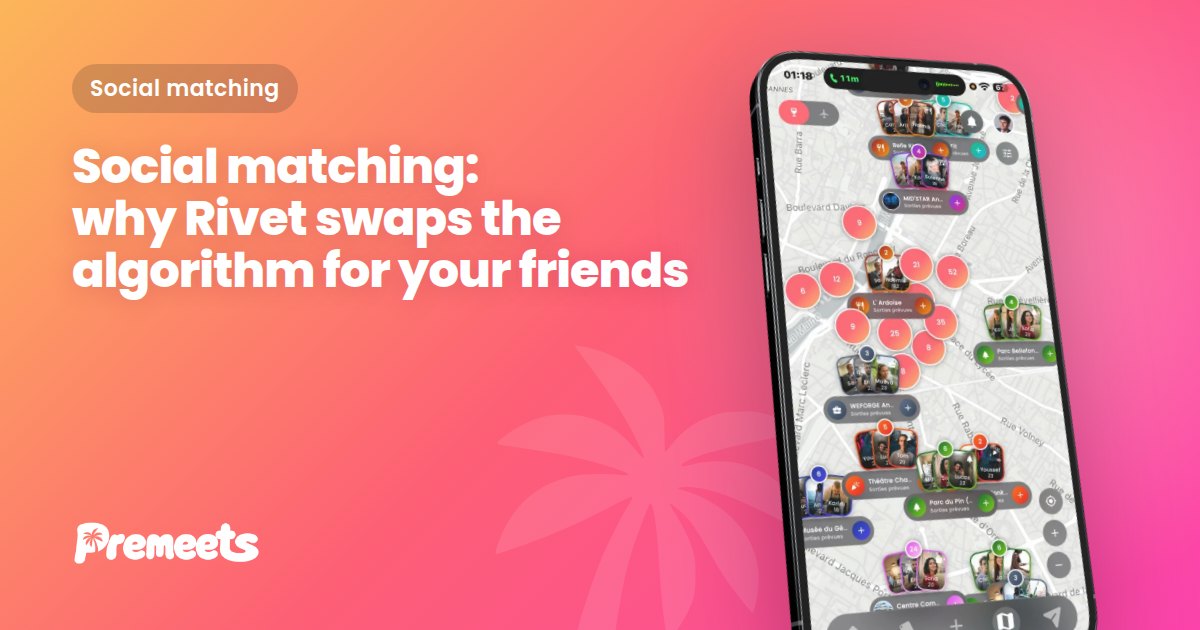
Rivet relies on a third party, a friend or a stranger, to choose on the user’s behalf. Premeets takes a different route, but starts from a similar observation: swiping alone, stripped of context, has ended up isolating people more than it’s brought them together.
Rather than leaving the call to a jury of friends or strangers, Premeets builds on something that already exists before the meeting itself: shared place and time. You share where you’re going and when (a bar tonight, a festival this weekend, a hotel, a campsite, an upcoming trip), and the app shows who else has planned the same thing, in the same place, at the same time.
This approach addresses several of the limits of classic swiping raised by these launches:
- no anonymous voting on strangers miles away: you see exactly who’ll be there, with the venue, neighbourhood and distance shown;
- not just for dating: Premeets also helps widen a friend group, travel solo with peace of mind, or find out who’ll be at your hotel or campsite;
- mutual filters (age, gender, dates, activities) that bring only the right people together, in both directions;
- messaging organised by plan (friends, outings, trips) to sort logistics out before arriving, rather than one generic chat thread.
The promise fits in a single sentence: arriving somewhere already knowing people. No need for a friend or a stranger to vouch for a pairing on your behalf, shared context already does much of the work.
What this launch says about what comes next
Whether Rivet succeeds or fails is still an open question, but its launch confirms one thing: bringing humans, friends and context back into the loop of meeting people is once again a compelling proposition, after years of solo optimisation. Whether through a jury of friends, as with Rivet, or through shared place and time, as with Premeets, the underlying trend looks the same, making dating social again, and a little less transactional.
Sources
This article draws on the following sources.
- A Former Tinder Executive Raised $10 Million for a New Dating App. Some of the People Making Matches Are Already Taken - inc.com (Inc, 24 September 2026)
- Dating App From Ex-Tinder Executive Lets Strangers Play Matchmaker - The Seattle Times (The Seattle Times, 24 September 2026)
- New app Rivet turns anyone into a matchmaker - Mashable (Mashable, 24 September 2026)
- Post LinkedIn de Rajat Sahni (LinkedIn)
- Post LinkedIn de Vasili N. (LinkedIn)
Ready to meet people before you arrive?
Read next
Dating apps · Online safety
Dating apps: scams, fake AI profiles and a trust crisis
Tinder Swindler launches his own dating app as AI-powered networks catfish thousands of users: a closer look at the dating apps' trust crisis.
4 min read
Dating apps · Meeting people IRL
Swipe fatigue: why dating apps want off the screen
CNN, The Cut and Flair.be document swipe fatigue and dating apps' push to meet up in real life. A closer look, plus another approach entirely.
5 min read