
- Dating apps
- Online safety
- Meeting people IRL
- Scams
Dating apps: scams, fake AI profiles and a trust crisis
Tinder Swindler launches his own dating app as AI-powered networks catfish thousands of users: a closer look at the dating apps' trust crisis.
By Mathis Mauprivez
4 min read
Contents
This week’s dating app news reads like a checklist of users’ worst fears: a globally notorious con artist is relaunching his own app, while several investigations reveal the scale of AI-powered catfishing. A timely reminder that dating app scams are no longer isolated stories but a genuine online safety issue. Between AI-generated fake profiles, paid chatbots and multi-million-pound romance scams, trust has become the real problem to solve, before we even get to swiping or algorithms.
Simon Leviev launches a dating app despite his past
Simon Leviev, real name Shimon Hayut, is the “Tinder Swindler” made infamous by Netflix’s 2022 documentary: he is alleged to have swindled several million pounds out of women he met on Tinder by posing as the heir to an Israeli diamond tycoon, according to LBC. Convicted of theft, fraud and forgery in 2019, he served a prison sentence and was banned from Tinder.
He has now announced the launch of his own app, called “Safe Love”, claiming he understands the “breaking points” of existing platforms, according to Metro. Appearing on ITV to discuss it, he was pushed by presenter Ben Shephard, who called the whole thing distasteful:
“There’s nothing nice about the Tinder Swindler, and nothing nice about what these women went through.” , Ben Shephard, cited by Metro
Leviev admitted he knows how to “lie”, “cheat” and “manipulate”, even referencing a fake passport he’d used in the past, before insisting he wants to “turn over a new leaf”, still according to Metro. Understandably, none of this does much to rebuild trust in dating apps.
AI networks are industrialising catfishing
That same weekend, The Verge documented a network of around thirty dating apps where most conversations involved no human at all, according to The Verge. Apps like Dora, Doni, Romi and Kira, available on the Google Play Store and the App Store, relied on AI personas, some of them powered by Anthropic’s Claude, to flirt with users and keep the conversation running.
According to Anthropic, cited by NDTV, more than 4,700 fake AI profiles chatted with at least 25,000 real people, with three profiles out of four entirely fabricated. A handful of gig workers were paid to take brief video calls or follow social media accounts, just enough to make the whole thing feel legitimate, while the AI handled the rest of the conversation:
“The majority of chats did not involve a human agent.” , The Verge
In practice, users bought “coins” or “gems” to keep chatting, without knowing they were talking, and paying, mostly a machine. Anthropic said the network could be traced back to a group based in China, and that some of the apps were still live on 17 September despite reports flagging them, according to NDTV.
A concrete case: $1.2 million lost in Norfolk
These scams don’t stay virtual. In Norfolk, Virginia, investigators say a man used dating apps to steal $1.2 million from his victims, according to WTKR. A figure that shows just how far a romance scam can go, well beyond a hijacked paid subscription.
Why the profile alone is no longer enough
All three stories point to the same conclusion: a profile, however polished, no longer guarantees anything. Today, a fake profile can combine:
- credible photos generated or edited with AI
- a smooth, natural chat history, kept running around the clock
- fake video calls, with a blurred background or a convenient excuse for never showing a face
- social media accounts followed by real, paid workers to make the whole thing look believable
Even selfie verification, meant to prove you’re talking to a real human, has its limits against faces entirely generated by AI, ones that a reverse image search simply can’t find. The usual signs of trust, verified badges, sharp photos, detailed bios, no longer say much about what’s actually happening behind the screen.
Premeets: betting on context rather than an isolated profile
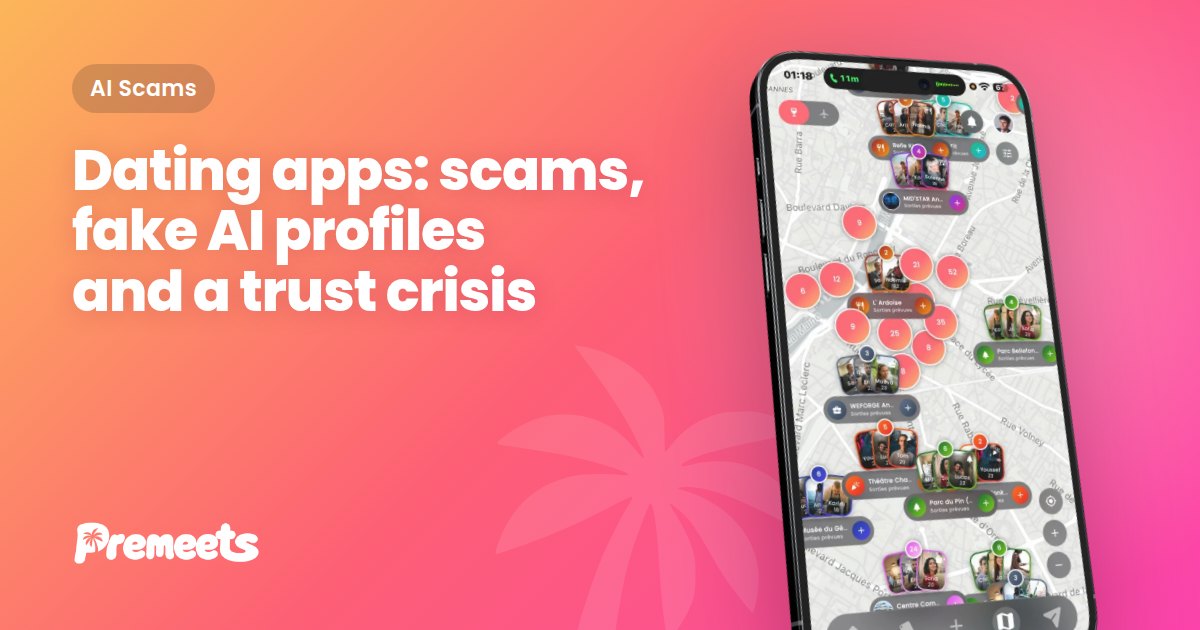
In light of this, Premeets takes a different approach to meeting people. Rather than matching two isolated profiles behind a chat, disconnected from real life, the app starts from a concrete context: a place and a moment in time. Users share where they’re heading (a bar tonight, a festival this weekend, a hotel, a campsite, an upcoming trip), and Premeets shows who else has the same place and the same timeframe in mind, with the venue, neighbourhood or distance displayed.
That starting point changes things: a real place and date, shared by several people at the same time, is far harder to fake than a lone profile with staged photos. Chatting is mainly there to help people organise before meeting up for real, not to keep a paid conversation going indefinitely. Premeets also offers mutual filters (age, gender, dates, activities), messaging organised by plan (friends, nights out, trips), plus reporting and blocking, with no reuse of data elsewhere. The app isn’t just about dating either: it’s also used to grow a friend group, travel solo with more confidence, or find out who else will be at the same hotel or campsite.
In conclusion
Between the Tinder Swindler’s return to the headlines and the discovery of entire networks of fake AI profiles, trust has become the real challenge for dating apps, well before any question of matches or swipes. Staying alert to money requests, video calls that always mysteriously fail, or profiles that seem too perfect remains essential. And rethinking how people meet around a real place and moment, rather than a standalone profile, is one concrete way to bring meaning back to trust online.
Sources
This article draws on the following sources.
- How investigators say a man used dating apps to steal $1.2M from Norfolk - WTKR (News 3 WTKR Norfolk, 17 September 2026)
- Ben Shephard branded 'the man' after losing temper grilling Tinder Swindler - Metro.co.uk (Metro, 17 September 2026)
- Dating App Scams Use Gig Workers, AI Chatbots To Deceive Thousands - NDTV (NDTV, 17 September 2026)
- The sexy AI-powered dating app scams are here - The Verge (The Verge, 16 September 2026)
- 'Distasteful' Tinder Swindler launches dating app after fraud sentence - lbc.co.uk (LBC, 16 September 2026)
Ready to meet people before you arrive?
Read next
Dating apps · Meeting people IRL
Swipe fatigue: why dating apps want off the screen
CNN, The Cut and Flair.be document swipe fatigue and dating apps' push to meet up in real life. A closer look, plus another approach entirely.
5 min read
Festivals · Travel
Dive into the Fêtes de Bayonne before you even arrive
Five days, five nights, a million people. How to meet the right festival-goers before you set foot in Bayonne.
1 min read