
- Dating apps
- IRL meetups
- Travel
- Friendship
Tinder x WeRoad: When the Dating App Bets on Real-Life Meetups
Tinder partners with WeRoad for IRL meetups between solo travellers. A look at the partnership, its limits, and what Premeets already offers.
By Mathis Mauprivez
5 min read
Contents
Tinder, the world’s most downloaded dating app, has just teamed up with Italian travel company WeRoad to organise real-life meetups between solo travellers in the United States. The WeRoad x Tinder IRL programme offers dozens of free events in Austin, Dallas and Los Angeles, with sign-up handled directly through the dating app. Behind this announcement, widely discussed on LinkedIn since 28 September, lies a clear takeaway: even the swiping giant now admits that genuine connection happens at a specific place and time, not through yet another profile to scroll past.
How WeRoad x Tinder IRL works
The concept is straightforward. WeRoad, known for organising group trips aimed at solo travellers, has launched a series of recurring, in-person events with Tinder across three American cities. According to WeRoad’s LinkedIn post, the programme includes 39 events over ten weeks, each one designed to stay “small enough to actually talk to people”, meaning small enough for participants to genuinely interact with one another.
The activities on offer cover a wide range:
- small-group yoga or workout sessions
- karaoke nights
- group running outings
- recurring themed workshops and meetups
Sign-up happens through the Tinder app, but the meetup itself takes place entirely in person. Paolo De Nadai, founder of WeRoad, sums up the spirit of the partnership on LinkedIn, explaining that 80% of people travelling with WeRoad are single, and that the point is “meeting 15 people at once, with zero social pressure”, rather than forcing an individual match. He rounds it off with a line that neatly captures the shift under way: “Swipe less. Live more.”
Why Tinder is betting on IRL now
This partnership didn’t come out of nowhere. It fits into a broader trend that Match Group, the parent company of Tinder and Hinge, has itself been documenting for several months. A Match Group-Ipsos survey of 1,000 single people in India found that 72% of respondents prefer fewer but deeper connections, and that 63% would rather keep looking than settle for an imperfect match, according to BusinessLine. The same survey reveals that 75% of respondents still socialise in person more than once a week, proof that real-life interaction has never really left the picture, even among the most digitally connected users.
The study, also covered by MediaNews4U, highlights a striking paradox: 35% of singles feel lonely often or always, even as 70% are actively working to build new social connections, and 58% say they feel connected online but isolated in real life. Anukool Kumar, regional lead at Match Group, sees this as proof that “young Indians are becoming more intentional about the kind of connection they want”, an intentionality that logically pushes dating apps towards more concrete formats than plain old swiping.
On top of this, there’s genuine competitive pressure at play. According to Yahoo Finance, the nationwide rollout of Rivet, a new platform founded by a former Match Group executive, leans precisely on a community-driven model built around social groups and referrals rather than plain profile swiping. The article notes that Match Group now needs to show, over the next twelve to eighteen months, that Tinder and Hinge are building in more community-driven or friend-led discovery features. The WeRoad partnership looks very much like an early, concrete response to that pressure.
What the scheme doesn’t solve yet
The WeRoad x Tinder IRL programme has the merit of grounding meetups in a specific place and time, exactly what users are calling for according to the surveys cited above. For now, though, it remains fairly limited:
- limited to three American cities (Austin, Dallas, Los Angeles)
- tied to a single travel partner, WeRoad
- designed as a ten-week pilot, with no guarantee of longevity or expansion to other countries
For anyone who doesn’t live in one of these three cities, or who simply wants to meet people during a trip, a night out or a festival elsewhere, the scheme changes nothing. What it does show, above all, is that the idea is gaining ground among the biggest players in the sector: linking a profile to a specific place and time works better than swiping without context.
What Premeets already offers, without relying on a single partner
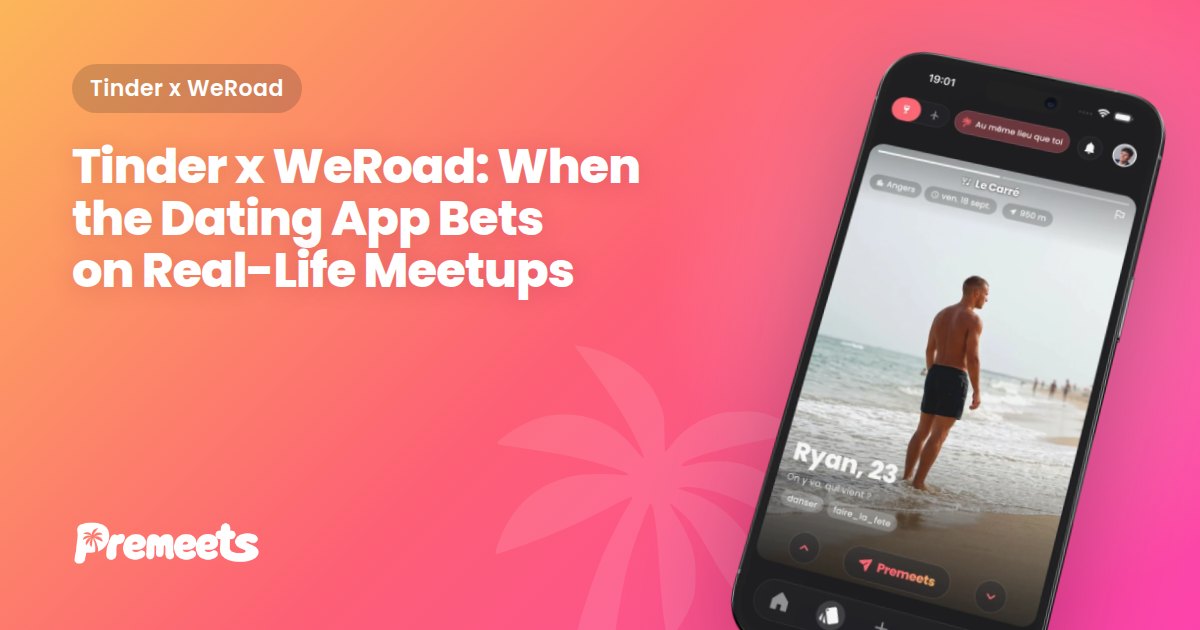
At Premeets, this isn’t a one-off idea, it’s the founding principle of the app. You simply say where you’re going and when, a bar tonight, a festival this weekend, a hotel, a campsite, an upcoming destination, and Premeets shows you who else has planned the same place at the same time. No need to wait for a travel company to organise an event in a specific city: the context is built around every single outing, wherever it takes place.
The difference also lies in what people are looking for. Premeets doesn’t reduce meeting people to dating: you might just as easily want to make friends when arriving somewhere alone, widen a group for a night out, or simply know who else will be staying at your hotel before you get there. Mutual filters (age, gender, dates, activities) ensure you only see what actually matches, and vice versa, while messaging is organised by plan (friends, nights out, trips), letting you sort things out before you even arrive.
Above all, this approach isn’t limited to one type of event, one city or a single commercial partner. Whether it’s a festival, a solo trip, a night out with friends or just a weekend away, the idea stays the same: arriving somewhere already knowing a few people, rather than swiping through strangers with no connection to where you actually are.
In short
The partnership between Tinder and WeRoad confirms a shift that Match Group’s own figures had already been pointing to: singles want less swiping and more real-life meetups, grounded in a shared place and moment. Even so, however appealing, this type of scheme still depends on a single partner, a single city and a limited timeframe. The logic of place and time before profile, on the other hand, can apply to any outing, anywhere, anytime.
Sources
This article draws on the following sources.
- Dating apps see shift from casual swipes to deeper connections - BusinessLine (BusinessLine, 28 September 2026)
- Match Group (MTCH) Is Confronting A New Dating App Rival - Yahoo Finance (Yahoo Finance, 27 September 2026)
- 35% of Indian singles feel lonely, 70% actively building social connections: Match Group-Ipsos survey - MediaNews4U (MediaNews4U, 26 September 2026)
- Post LinkedIn de Dan J. Berger (LinkedIn)
- Post LinkedIn de Paolo De Nadai (LinkedIn)
Ready to meet people before you arrive?
Read next
Dating apps · Meeting people IRL
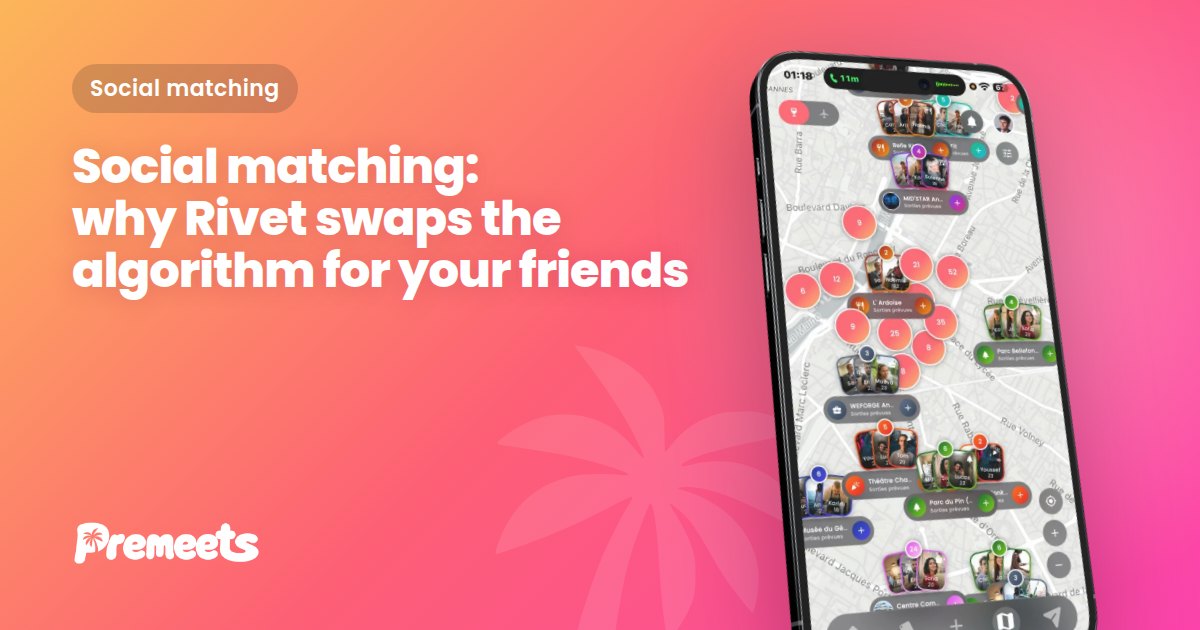
Social matching: why Rivet swaps the algorithm for your friends
Rivet, launched by a former Tinder executive, lets friends and strangers pick your matches. Here's what this shift to social matching reveals about dating apps.
4 min read
Travel · Friendship
Make your holiday friends now, not on the last day
The best holiday friendships tend to arrive far too late. Here is how to get ahead of them.
1 min read