
- Dating Apps
- IRL Dating
- Swipe Fatigue
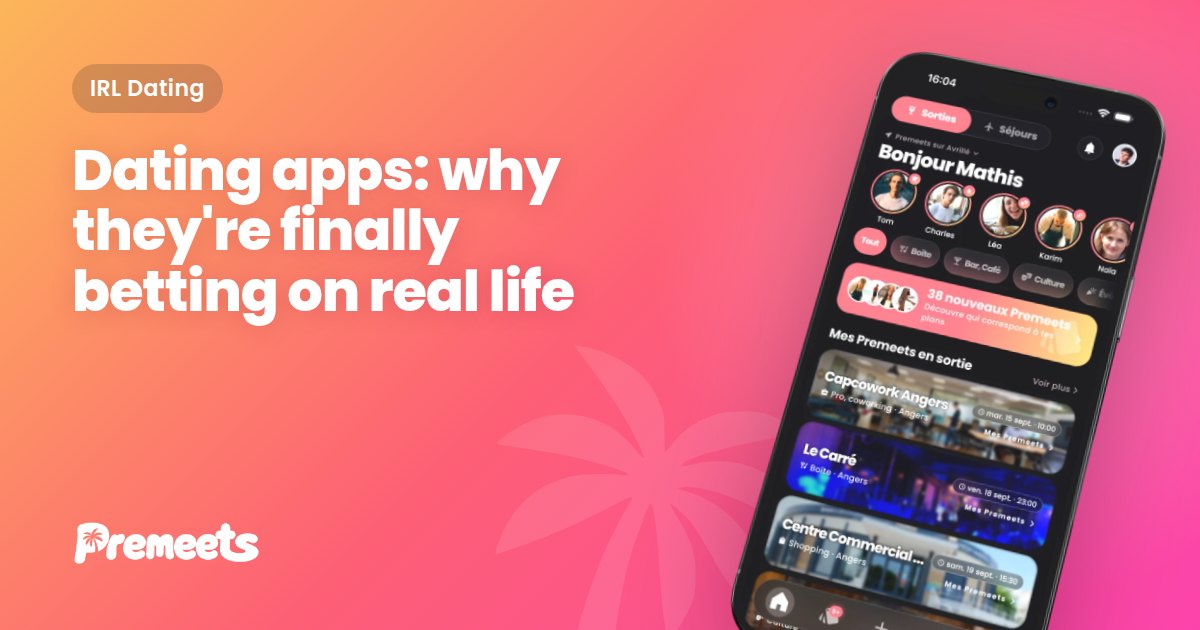
Dating apps: why they're finally betting on real life
Pickleball, trivia nights and singles mixers: dating apps are ditching the endless swipe to finally spark real, in-person connections offline.
By Mathis Mauprivez
5 min read
Contents
In just a few days, Fortune, Presse-citron, the Toledo Blade and the NZ Herald told the same story: dating apps are moving away from pure swiping to organise real meetups, from pickleball to trivia nights. A new app called “Meeting Mutuals” goes even further, promising, according to KOIN, to get singles off their screens altogether. This shift confirms something we’ve believed since Premeets launched: it’s better to meet in the right place, at the right time, than to chat endlessly behind a profile.
Swipe fatigue is now backed by data
The term “dating app fatigue” is no longer just a feeling, it’s become a subject of study. ThePrint even compares it to doomscrolling for love: endlessly scrolling through profiles, with the same exhausting effect as an anxiety inducing news feed.
The figures cited by Fortune give a sense of the scale of the problem. A study by Clarity Check, surveying almost 9,000 respondents, found that 58% of those surveyed had deleted a dating app because they found it “emotionally exhausting”, and that 44% would rather meet someone in a low pressure setting than discover them through a profile, according to Fortune.
This weariness shows up directly in the results of the sector’s giants. Still according to Fortune, Tinder’s daily active users fell 4% year on year in the second quarter, and its paying users dropped to 8.5 million, an 11.5% decline over two years. Bumble has seen an even sharper drop, with 3.2 million paying users compared with 4.1 million two years earlier, a 24% fall.
Tinder and Bumble: from swipe to organised meetups
Faced with this, the sector’s two giants are pulling the same lever: getting users off the screen rather than keeping them on it longer. Tinder launched an Events feature in March, first tested in Los Angeles before expanding to around twenty cities, mostly in the US but also in Europe, Fortune reports.
The idea, explained by Tinder’s chief product officer Mark Kantor, is to drop the “dating event” label and instead offer activities users already enjoy, in partnership with brands such as City Pickle, Joust and Othership. Among the activities listed by Fortune:
- pickleball sessions,
- trivia nights,
- sauna and cold plunge sessions.
According to Kantor, this shared ground changes the nature of the encounter: “The activity gives people a natural starting point, and the shared experience takes some of the pressure out of meeting someone new,” he told Fortune. The result in Los Angeles: 71% of Gen Z users have visited the Events feature since launch, compared with 63% of users aged 25 and over, still according to Fortune.
Bumble is following a similar logic, taking over bars in New York for singles mixers, hosting a rooftop event in Nashville, and running an event with the Barstool Sports account in Boston. A spokesperson quoted by Fortune sums up the approach: “IRL has been part of Bumble’s DNA from the start.”
Breeze and “Meeting Mutuals”: no chat, straight to the date
Other, younger players are pushing the logic even further by simply scrapping the endless messaging altogether. That’s the case with Breeze, an app based in Delft, in the Netherlands, with a team of 41 people and around $7 million raised, according to Fortune.
Its approach breaks with industry standards: each user only receives a handful of profiles a day, and if there’s a match, both people simply share their availability rather than opening a conversation. Breeze then arranges the date at a partner venue, and charges per date rather than through a subscription.
Marco van der Woude, Breeze co-founder, defends this approach to Fortune:
“A short real world date reveals more about compatibility than weeks of texting can, faster and with less of the anxiety that endless chat creates.”
In the same spirit, the “Meeting Mutuals” app positions itself, according to KOIN, as a tool designed to help singles leave dating apps rather than stay glued to them.
Friends and family are getting involved too
The shift towards real life isn’t limited to events. It’s also changing how apps bring singles’ friends and family into the picture, as Presse-citron details. This summer, Hinge launched a “Signals” badge to reassure users about a profile’s authenticity, followed by “Friends Take”, a feature letting friends and family comment directly on a user’s profile.
The app draws on telling internal data: 71% of Hinge users would like help creating their profile, but only 46% actually dare to ask for it, according to Presse-citron. More broadly, 79% of singles turn to friends and family for advice on their love life. Tinder paved the way back in 2023 with MatchMaker and Double Date, while Bumble lets users send a profile to a friend who might be interested.
All these initiatives share the same goal: making dating feel less mechanical, less solitary, and closer to how people actually meet, through friends or connections.
Premeets: context before the profile
What these announcements confirm is something we’ve believed since day one at Premeets. Rather than bolting events onto a system built for swiping, we chose to start from context: place and time first, profile second.
On Premeets, you say where you’re going and when, a bar tonight, a festival this weekend, a hotel stay or a camping trip, and the app shows you who else has the same place and time slot planned. Mutual filters for age, gender, dates and activities ensure everyone only sees what matches them, and vice versa. Messaging is organised by plan (friends, nights out, trips), so you can arrange things before you even get there.
This approach also answers a need highlighted by the studies mentioned above: not just looking for romance, but also widening your circle, making friends, or simply knowing who’ll be at your hotel or campsite before arriving there alone.
The principle stays simple: arrive somewhere already knowing people, rather than chatting for weeks behind a screen before maybe meeting.
The movement seen in recent days, from pickleball courts to trivia nights, shows the whole industry converging on the same instinct: meeting people needs a real world anchor to matter. That’s exactly what Premeets has offered from the start, putting place and time before the profile.
Sources
This article draws on the following sources.
- ‘Meeting Mutuals’ hopes to get singles off dating apps - KOIN.com (Dating apps EN, 21 September 2026)
- Hinge lance une nouvelle fonctionnalité : mais pourquoi les apps de rencontre sont obsédées par nos amis ? - Presse-citron (Presse-citron, 20 September 2026)
- Dating app fatigue is real. It’s doomscrolling for love - ThePrint (Dating apps EN, 20 September 2026)
- Dating apps are trying to cure swiping fatigue with pickleball, trivia nights, and fewer chats - Fortune (Fortune, 20 September 2026)
- Dating apps are ditching ‘the swipe’ for meet-ups IRL - Toledo Blade (The Blade, 20 September 2026)
- Dating apps may skew your idea of romance. Here’s how to reclaim it - NZ Herald (NZ Herald, 20 September 2026)
Ready to meet people before you arrive?
Read next
Dating apps · Online safety
Dating apps: scams, fake AI profiles and a trust crisis
Tinder Swindler launches his own dating app as AI-powered networks catfish thousands of users: a closer look at the dating apps' trust crisis.
4 min read
Dating apps · Meeting people IRL
Swipe fatigue: why dating apps want off the screen
CNN, The Cut and Flair.be document swipe fatigue and dating apps' push to meet up in real life. A closer look, plus another approach entirely.
5 min read