
- Dating Apps
- Artificial Intelligence
- IRL Dating
- Authenticity
AI on Dating Apps: Who's Really Writing Your Messages?
Bios, opening lines, replies: AI is taking over dating apps. Several US news outlets are now questioning the authenticity of these exchanges.
By Mathis Mauprivez
4 min read
Contents
This week, no fewer than five US news stations, CBS19, KHOU, KVUE, Local 3 News and KCRA, each ran a segment on the very same phenomenon: artificial intelligence writing on users’ behalf on dating apps. Polished bios, generated opening lines, suggested replies: the observation is shared across the board, and the same question keeps coming up, almost word for word: could this AI be harming real connections?
When AI writes bios and opening lines
The segment aired by CBS19 describes an AI that now helps users “polish their profiles and craft their messages”. This is no longer a marginal detail: according to KHOU, AI is literally becoming the “wingman” of dating apps, feeding users the right lines before the first conversation even starts.
KVUE and Local 3 News go further and call it a “dilemma”: AI makes it easier to strike up contact, but it also blurs the line between what the other person reads and what their match is actually thinking.
A LinkedIn post by John Kindred shares a concrete example: Jack, 38, a data scientist in San Francisco, asked ChatGPT for “a fun short writeup of who I am for a dating app”, then pasted the answer straight into his Hinge profile. The result? No improvement to his already low response rate.
An old debate, a new level
Dating apps have relied on algorithms for years, and on AI since 2023, particularly for facial recognition or compatibility scoring. What’s changing now is that AI no longer just sorts things in the background: it speaks on your behalf.
That’s exactly what Douglas Zytko, a computer science professor at the University of Michigan-Flint, points out in John Kindred’s LinkedIn post:
“All I’m seeing is, okay, it’s still algorithms matching, but humans have less agency over that process” (Douglas Zytko, via LinkedIn)
In other words, matching already existed, but people have less and less control over what they actually say to each other.
The apps themselves are driving the shift
This isn’t limited to a handful of users quietly tinkering with ChatGPT. Dating apps are now officially building it into their features. According to findings shared on LinkedIn:
- Hinge offers personalised help with profile creation and conversation starters.
- Bumble is moving towards AI-driven matchmaking rather than simple swiping.
- Grindr is trialling bot-to-bot conversations to “vet” a date before it happens between actual humans.
- Lamp, an app built around an assistant called Genie, suggests bios, opening lines and date ideas, while making clear it “never messages in your name”, according to a LinkedIn post comparing Hinge and Lamp.
That last distinction says a lot: even apps that sell AI as a feature feel the need to reassure users on one specific point, namely who is actually typing when it comes to messaging someone.
The real question: who’s talking to whom?
This is where the debate gets interesting. As long as AI helps one person express what they already think more clearly, it remains a support tool. The problem starts when both sides of the conversation lean on AI, from the first message right through to picking a restaurant.
A LinkedIn post by Aron K., about an app called ZeroDate, sums up the risk neatly:
“Two systems scheduling coffee for two strangers isn’t connection, it’s logistics wearing a human costume” (Aron K., via LinkedIn)
The logic holds up: AI can filter out the noise, spot compatibility, handle the scheduling. But the moment two people actually meet, no language model can carry the conversation for them. And that moment is precisely what, for many users, makes being on a dating app worthwhile in the first place.
Premeets: context first, not the perfect text
All this unease around AI stems from the same starting point: on most apps, it’s a piece of text (a bio, an opening line, a reply) that has to win over a stranger, often miles away, before a meeting has any chance of happening. And the more that text matters, the more tempting it becomes to have someone, or something, else write it.
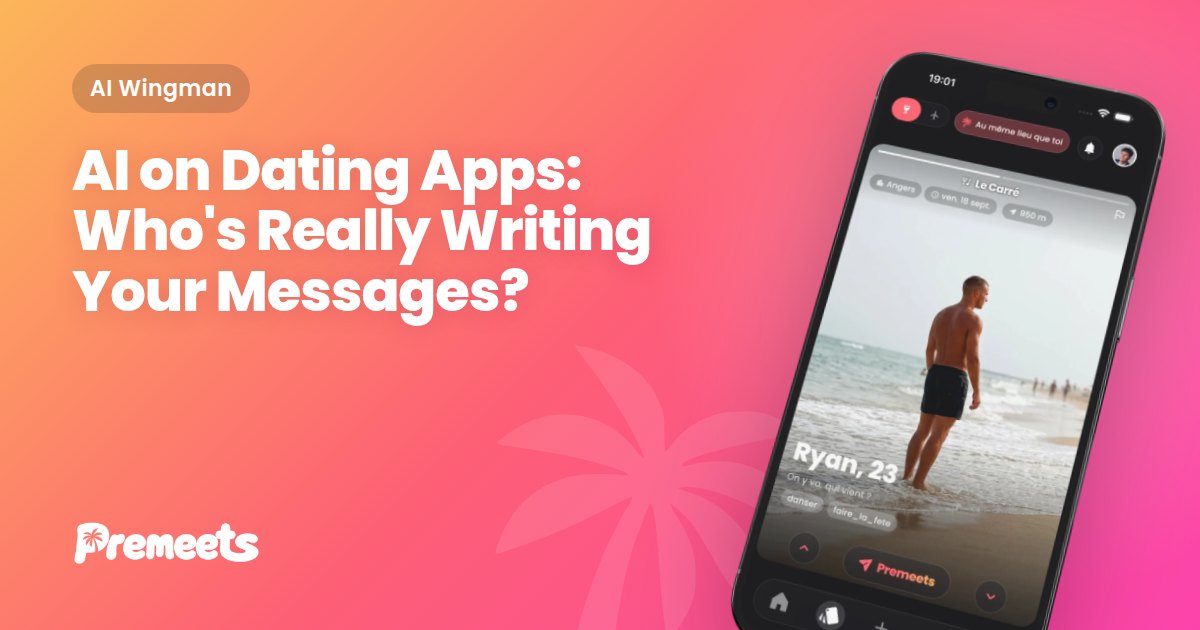
Premeets shifts that starting point. Instead of swiping through profiles from a distance, users share where they’re going and when: a bar tonight, a festival this weekend, a hotel or campsite during a trip. The app then shows the people who have planned to be at the same place, at the same time, along with the venue, the neighbourhood and the distance.
What brings two people together on Premeets isn’t a well-crafted bio or a clever opening line, it’s real, close-in-time context. Any conversation before meeting up is there to sort out logistics (where to meet, what time), not to sell yourself across several back-and-forth messages. And once you’re there, there’s no room left for an artificial wingman, just two people who already knew they’d be in the same place.
This logic applies well beyond dating too. Premeets is also used to expand a group at a festival, find out who’s staying at the same campsite, or simply avoid showing up somewhere alone. Mutual filters (age, gender, dates, activities) and messaging organised by plan (friends, nights out, trips) keep the conversation focused on sorting out the moment, not on performing through text.
In short
AI writing on users’ behalf isn’t a one-off story: it’s a trend documented by several US news outlets in the very same week, with one question coming up again and again, that of who is really talking to whom. One way to answer it is to rely less on the text that precedes a meeting, and more on the real context that leads straight to it.
Sources
This article draws on the following sources.
- AI is helping dating app users polish profiles and craft messages - cbs19.tv (Dating apps EN, 23 October 2026)
- AI is becoming a dating app wingman. Could it hurt real connections? - KHOU (Dating apps EN, 22 October 2026)
- The AI dating app dilemma - KVUE (Dating apps EN, 22 October 2026)
- (LKL) LOVE, LIES & ALGORITHMS: THE AI DATING APP DILEMMA - Local 3 News (Local3News.com, 22 October 2026)
- Post LinkedIn de John Kindred (LinkedIn)
- Post LinkedIn de Aron K. (LinkedIn)
- Post LinkedIn de Lamp Dating (LinkedIn)
Ready to meet people before you arrive?
Read next
Dating Apps · IRL Dating
Dating apps: why they're finally betting on real life
Pickleball, trivia nights and singles mixers: dating apps are ditching the endless swipe to finally spark real, in-person connections offline.
5 min read
Dating Apps · Digital Fatigue
Hinge, the app 'designed to be deleted': the real paradox
Hinge claims it's designed to be deleted, but its business model relies on you staying active. A look at the paradox shared by every dating app.
4 min read