
- Dating Apps
- Digital Fatigue
- Meeting IRL
Hinge, the app 'designed to be deleted': the real paradox
Hinge claims it's designed to be deleted, but its business model relies on you staying active. A look at the paradox shared by every dating app.
By Mathis Mauprivez
4 min read
Contents
This week, several English-language outlets, from The Telegraph to the US student press, have revisited Hinge’s slogan, “the dating app designed to be deleted”, to unpick how it actually works: how can a company that depends on your presence on the app sincerely want to see you leave? This paradox, far from unique to Hinge, calls into question the whole business model of dating apps, whether ad-funded or subscription-based, just as an Alfa Romeo study puts dating app fatigue among users at 60%, according to Stellantis.
“Designed to be deleted” versus the reality of the business model
Hinge’s promise is well known: help users land a good date, then nudge them off the app, towards “something real, in person”. Hinge’s CEO, Jackie Jantos, sums it up in an interview quoted by the student newspaper The Phoenix:
“At Hinge, we hold ourselves to one outcome: helping people get to a great date.”
The trouble, as an investigation by Straight Arrow News points out, is that Hinge belongs to Match Group, a $9 billion technology company that also owns Tinder and OkCupid. A listed company needs recurring revenue, not customers who leave satisfied after a fortnight.
Negative churn, positive churn: fatigue as a side effect of the system
This is where the business jargon becomes revealing. Researcher Liesel Sharabi, interviewed by Straight Arrow News, explains that dating apps face two kinds of “churn” (user loss): “negative churn”, when people leave disappointed, much like on a typical social network, and “positive churn”, when people leave because they have found someone. In other words, a dating app’s very success, finding love, empties it of its users.
Some Hinge users have even filed formal complaints with the US Federal Trade Commission, accusing the platform of deceptive business practices and algorithmic manipulation, again according to Straight Arrow News. Lauren Conrad, a user interviewed for that same investigation, sums up the suspicion now widely shared:
“They want money, pure and simple.”
A week of criticism, from satire to self-defence
The subject isn’t being covered in just one register. The Telegraph has published a deliberately provocative op-ed suggesting the UK government should “nationalise Hinge” to boost the birth rate, echoing Andy Burnham’s pledges to nationalise water companies, according to The Telegraph. The New Statesman, for its part, describes the “embarrassment” that Hinge has become in public debate, according to New Statesman.
Conversely, Swarthmore College’s student paper leaps to the app’s defence: its author, who describes herself as a “Hinge Warrior” with more than 2,400 matches in four years, argues the problem isn’t the tool but how people use it, according to The Phoenix. She recommends intentionality, vulnerability, consistency and good timing to avoid the trap of passive scrolling, the very same trap the harshest critics describe.
The figure everyone agrees on: 60% fatigue
Beyond opinion, one figure keeps coming up and gives the debate real structural weight. According to a OnePoll survey carried out for Alfa Romeo among 1,000 single Britons in September 2026, 60% of people who date frequently say they experience dating app fatigue, according to Stellantis. The same report also found that:
- 49% of respondents would rather meet potential partners more naturally, away from apps.
- 91% of women want more control over how a date is planned.
- 86% of those surveyed say the feeling of an in-person meeting, the “chemistry”, is decisive.
- 44% would be more likely to agree to a date built around a shared experience (a walk, an outing) rather than a plain dinner.
Jules Tilstone, managing director of Alfa Romeo UK, sums up this shift in a line that echoes almost every criticism of the Hinge model: “Dating apps have transformed the way people meet, but our research suggests singles are now looking for a more authentic way to connect”, reports Stellantis.
Why occasional use escapes this paradox
What this week in the press reveals is that Hinge’s paradox isn’t a design accident but the logical result of a model built around continuous engagement: more time spent, more swipes, more data, more ad or subscription value. An app whose profitability depends on your daily presence structurally has no interest in you leaving quickly, even if that’s what it promises.
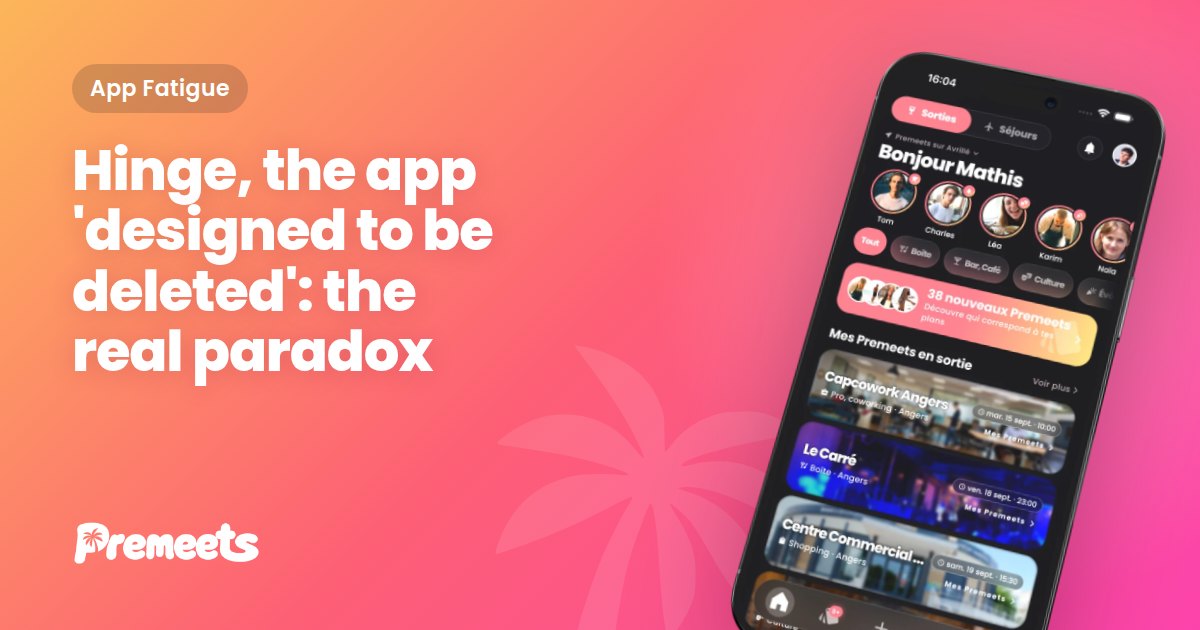
This is exactly what Premeets does differently. Instead of offering an endless feed of strangers to scroll through, the app starts from a specific place and moment: a bar tonight, a festival this weekend, a hotel or campsite during a trip. You see who else has the same spot booked in for the same slot, with the venue, the neighbourhood and the distance shown, then you chat before actually meeting up. Use has a natural start and end, that of the plan itself, with no need to stay logged on constantly for the service to remain useful.
The same logic applies to romantic dates just as much as to making friends or going out: travelling solo while knowing who else will be at your campsite, widening a group for a night out, or simply turning up somewhere already knowing people. Mutual filters on age, gender, dates and activities mean you only see what matches, and vice versa, while messaging organised by plan (friends, nights out, trips) avoids the endless-inbox feeling so many Hinge users describe. Reporting and blocking stay active at all times, and data isn’t reused elsewhere.
In conclusion
The row over Hinge isn’t just a passing grumble: it points to a structural tension between the promise of “disappearing” and a model that needs you to stay. Starting from a specific place and moment, rather than an endless feed to scroll through, changes the equation: the app serves the plan, not the other way round.
Sources
This article draws on the following sources.
- The Garnet Letter: You’re Using Hinge Wrong — In Defense of Dating Apps - The Swarthmore Phoenix (The Phoenix, 8 October 2026)
- Alfa Romeo research reveals dating app fatigue among 60% of daters, while 91% of women want greater control over date plans - Media Stellantis (Dating apps EN, 8 October 2026)
- Generational warfare, the embarrassment of Hinge, and Jeffrey Archer's shepherd's pie parties - New Statesman (Dating apps EN, 7 October 2026)
- Hinge is ‘the dating app designed to be deleted.’ Some users say it keeps them hooked - Straight Arrow (Straight Arrow, 6 October 2026)
- Labour should nationalise Hinge - The Telegraph (The Telegraph, 6 October 2026)
Ready to meet people before you arrive?
Read next
Dating Apps · IRL Dating
Dating apps: why they're finally betting on real life
Pickleball, trivia nights and singles mixers: dating apps are ditching the endless swipe to finally spark real, in-person connections offline.
5 min read
Nightlife · Meeting People IRL
The 50 Best Cities for Nightlife in France in 2026
The 50 best cities for a night out in France in 2026, mapped region by region, with tips on how to meet people there without ever heading out alone.
7 min read