- Dating apps
- Meeting people IRL
- Swipe fatigue
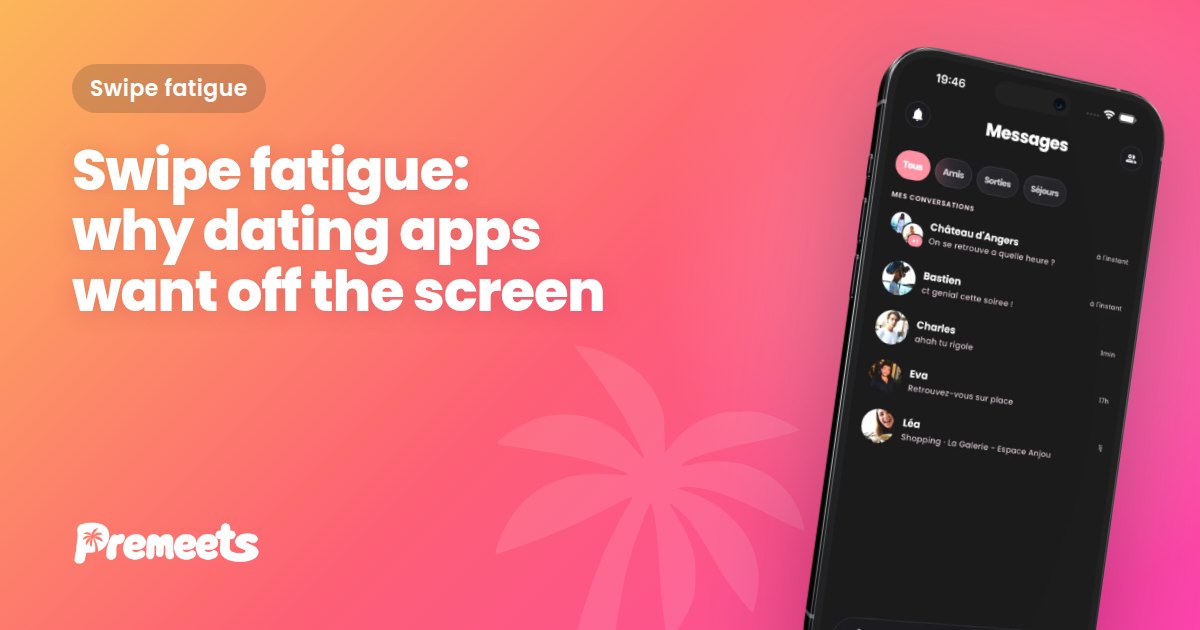
Swipe fatigue: why dating apps want off the screen
CNN, The Cut and Flair.be document swipe fatigue and dating apps' push to meet up in real life. A closer look, plus another approach entirely.
By Mathis Mauprivez
5 min read
Contents
This week, several outlets published, almost at the same time, the same finding: swipe fatigue is setting in, and dating apps are trying, one way or another, to get their users off the screen. CNN, The Cut and Flair.be each tell this shift in their own way, between falling numbers, new formats and parties that sometimes fall flat. It’s enough to make you wonder what’s really missing for meeting people IRL to actually work.
A week when everyone says the same thing
The clearest signal comes from the numbers. According to CNN, Match Group (the parent company of Tinder, Hinge, Match and OkCupid) saw its paying subscribers drop 6% year on year, to 13.3 million, while Bumble lost 16.4% of its paid user base, falling to 3.2 million users (CNN). The outlet also cites a striking statistic: 78% of dating app users report experiencing some form of burnout.
On the French side, Flair.be relays a 2025 Ipsos study according to which 61% of dating app users feel this same weariness, a phenomenon that writer Judith Duportail had already theorised back in 2020 under the name “dating fatigue” (Flair.be). The symptom is always the same: profiles that all look alike, conversations that go nowhere, and an hour of swiping that leaves you feeling emptier than before.
Established apps try to get off the screen
Faced with this wall, industry players are multiplying initiatives to push users towards real life. CNN paints a fairly broad picture:
- Surf, an app that replaces swiping with a grid of profiles filtered by interests, known for organising meet-ups around Hyrox competitions;
- Breeze, born in the Netherlands, which does away with messaging entirely and gives users a location and time slot directly at a partner bar, with group dinners for 6 to 10 singles;
- Feeld, which organises themed outings (bowling, climbing, comedy) to carry the conversation beyond the app;
- Tinder, which is launching an events page, and Bumble, which is testing a feature for organised in person dates in place of classic swiping.
The thinking behind these choices is summed up by Abigail Gaskin, brand director at Feeld, who explains that digital has its limits: “There’s only so much you can do online,” she told CNN (CNN). She also points to a quiet weariness with exchanges that feel too repetitive and transactional, and the need for a bit of friction, simply getting up, getting ready, travelling somewhere, to bring meaning back to meeting someone.
When the organised night out falls flat
But getting off the screen isn’t always enough. The Cut recounts the launch of Readme, a dating app for readers created by Banu Guler (founder of Co Star) and writer Emily Segal, co-hosted with authors such as Caroline Calloway and Marlowe Granados. The article’s headline says it all: “Why Didn’t Anyone Flirt at the Dating-App Party?” (The Cut).
Bringing strangers together around a vague theme, in this case a love of books, doesn’t automatically recreate the conditions for a genuine encounter. Attendees sometimes turn up out of curiosity rather than a desire to flirt, and the atmosphere of a mixer stays artificial even when it’s well thought out.
Flair.be, meanwhile, tells the story of a more spontaneous approach: Spoons, a T-shirt brand dreamed up by Caroline, 24, featuring a QR code on the back that links to a profile. The idea is to openly signal that you’re open to meeting someone, without any messaging or matching system. As she puts it: “You swipe and spend an hour on your phone just scrolling through guys’ faces. And then people aren’t very engaged, it’s a bit impersonal” (Flair.be).
Why these attempts sometimes struggle to take off
These initiatives share a common trait: they try to artificially recreate a meeting context by bringing strangers together around a theme (books, sport, a T-shirt) rather than around a real, already shared plan. But a mixer is still a mixer: participants don’t know each other, have no concrete reason to be there together, and have to improvise group chemistry on demand.
By contrast, what works best in the examples mentioned, such as Surf’s Hyrox meet-ups or Breeze’s group dinners, relies on a genuine, dated shared point: a specific sporting event, an evening at a given bar at a set time. That shared context, the place and the moment, seems to make all the difference between a night where “nobody flirts” and an encounter that actually clicks.
A different approach: starting from plans already in motion
That’s exactly the problem Premeets is trying to solve, but by working the other way round. Rather than organising an artificial event to bring strangers together, the app starts from the real plans people already have: a bar tonight, a festival this weekend, a hotel, a campsite, an upcoming travel destination.
In practice, everyone indicates where they’re going and when. Premeets then shows who else has planned the same place at the same time, displaying the venue, neighbourhood and distance before you even see a full profile. The conversation starts from this concrete, shared basis, not from a generic opening line.
This logic also changes the nature of the encounters made possible. As the app points out, it isn’t just about flirting: Premeets is just as useful for making friends, expanding a group for a night out, or finding out who else will be staying at your hotel or campsite before you even arrive. Mutual filters (age, gender, dates, activities) and messaging organised by plan (friends, nights out, trips) let people sort things out before ever meeting up in person, which is exactly what helps avoid the pitfall of a night where nobody knows why they’re there.
In summary
Swipe fatigue is no longer just a feeling: Match Group and Bumble’s numbers confirm it, and the new formats being tested by established apps prove it in practice. But bringing strangers together around an artificial theme isn’t enough to recreate real chemistry. What seems to be missing, and what several of these initiatives are rediscovering through trial and error, is a shared, real, dated context, the very thing Premeets treats as the starting point rather than a fallback solution.
Sources
This article draws on the following sources.
- Why Didn’t Anyone Flirt at the Dating-App Party? (The Cut, 14 September 2026)
- Marre de Tinder? Enfilez ce t-shirt pour faire des rencontres dans la vraie vie (Flair.be, 14 September 2026)
- Dating apps are ditching ‘the swipe’ for meet-ups IRL (CNN, 12 September 2026)
Ready to meet people before you arrive?
Read next
Festivals · Travel
Dive into the Fêtes de Bayonne before you even arrive
Five days, five nights, a million people. How to meet the right festival-goers before you set foot in Bayonne.
1 min read
Travel · Friendship
Make your holiday friends now, not on the last day
The best holiday friendships tend to arrive far too late. Here is how to get ahead of them.
1 min read