
- Dating Apps
- Meeting People IRL
- Friendship
Tinder Group Hangouts: why one-on-one dates feel so daunting
Tinder launches Group Hangouts to ease the pressure of solo dates on the app. We break down the feature and a different way to meet people for real.
By Mathis Mauprivez
4 min read
Contents
On 1 October 2026, Tinder unveiled “Group Hangouts,” a feature that replaces the classic one-on-one date with outings between groups of friends built around a shared activity. The idea: ease the pressure of face-to-face dating by bringing friends back into the equation. It’s a strong signal for the whole dating app industry, which is increasingly admitting that one-on-one dates are daunting.
How Group Hangouts works
The concept is simple enough to describe. You create a group of at least three people, choose an activity, then invite friends to join. Once a group is formed, its profile is shown to other groups of similar size, and everyone can also browse the groups on offer, as explained by Dataconomy.
When two groups match, a group chat opens so everyone can decide whether to actually meet up. Everyone keeps control: it’s possible to leave the group or the conversation at any time, and Tinder’s usual reporting and blocking tools stay active, as Complex points out.
For now, the feature is rolling out first in the United States and a handful of selected markets. There’s nothing to suggest a UK or European launch just yet, as Android MT notes, pointing out that “no date has leaked out on this side of the Atlantic.”
The numbers behind the shift
Tinder isn’t launching this feature at random. It’s building on results from its Double Date mode, launched last year, and on early Group Hangouts tests carried out in Australia:
- around 90% of users who tried double dates are under 30, according to Android MT and 24matins;
- matches formed through this mode exchanged 35% more messages than a standard date, per the same sources;
- in Australia, 40% of Group Hangout invitations were accepted, reports htxt.co.za;
- once groups are formed, women are 2.2 times more likely to like a group profile than an individual one, again according to htxt.co.za.
For Tinder, this reading confirms a trend spotted since Double Date launched. Mark Kantor, the app’s chief product officer, sums up the ambition in a statement quoted by Complex:
“Double Date proved something we suspected all along: young singles want their friends in the mix when they’re meeting someone new.”
The real issue: fear of the one-on-one date
What this launch really reveals is an implicit admission from the leading swipe app: the one-on-one date, the sector’s historic cornerstone, makes a good number of users uneasy. The headline of htxt.co.za’s piece says it outright, referring to people “too daunted by the prospect of a one-on-one date.”
24matins describes an option “designed as a lighter alternative to the classic face-to-face date,” one that removes pressure while keeping the sense of discovery. The outlet concludes simply: “Quite a few signals are converging here, clearly.”
That’s the observation we find most interesting. The unease doesn’t just come from the stranger you’re about to meet, but from the format itself: finding yourself alone with someone you only know through a few messages and a handful of photos.
What Group Hangouts doesn’t really solve
Group Hangouts addresses this anxiety by putting more people round the table, but the starting mechanism is still the virtual match. You still have to form a group, swipe through collective profiles, wait for a match, then negotiate a time and place in a chat before anyone actually meets. The social side exists on screen first, not yet on the street.
In other words, the feature moves the anxiety around (you’re no longer alone facing a stranger) without tackling the uncertainty of the meetup itself: will the group actually turn up, in the right place, at the right time? For now, none of the sources explain how Tinder handles that final step, the one that turns a match into an actual meetup.
Premeets: starting from the place and the moment, not the match
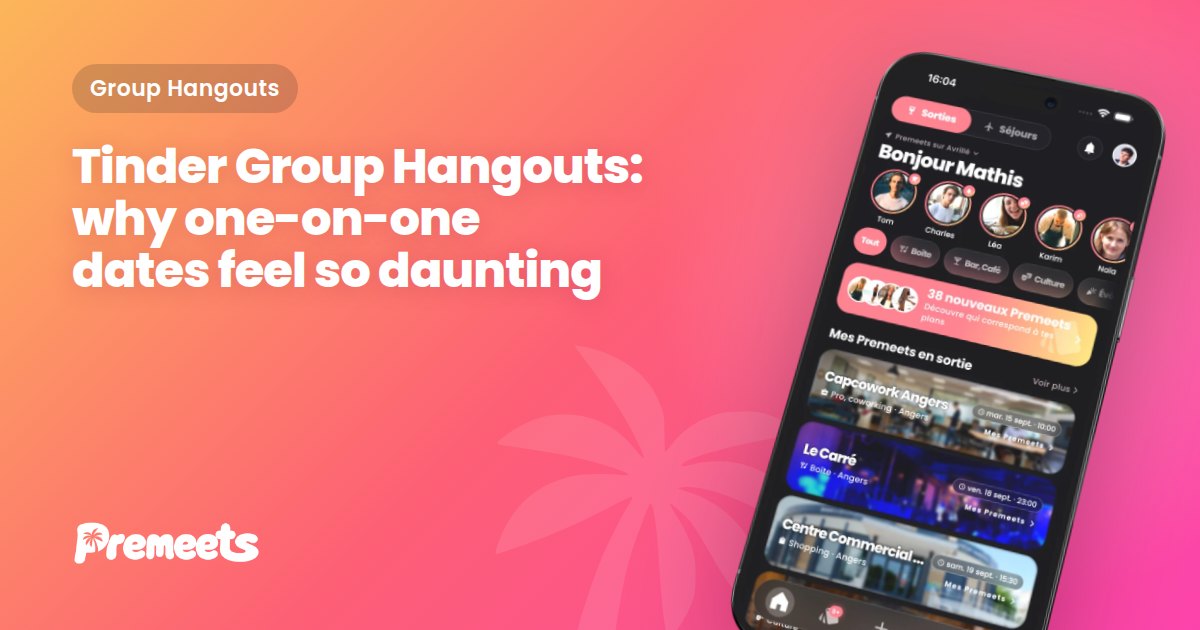
This is exactly where Premeets takes a different approach. Rather than matching a profile or a virtual group first and organising an outing afterwards, the app starts from something concrete: you say where you’re going and when, a bar tonight, a festival this weekend, a hotel, a campsite, an upcoming trip. Premeets then shows who else has the same place and time planned, with the venue, the neighbourhood and the distance displayed.
Context comes before the profile: no blind swiping through distant strangers, just people you already know will be there, at the same time as you. That removes a good chunk of the uncertainty Group Hangouts is trying to soften on the format side, since the meetup is no longer hypothetical but anchored in a real place and date.
Premeets isn’t limited to dating as a couple or within a closed group either. The app also helps you make friends, grow a group you’re already part of, or find out who’ll be staying at your hotel or campsite before you even arrive. Mutual filters (age, gender, dates, activities) and messaging organised by plan (friends, outings, trips) let you get sorted before you turn up, with reporting and blocking tools ready to keep everyone safe.
In short
With Group Hangouts, Tinder is admitting that one-on-one dates feel intimidating and that being part of a group feels reassuring. It’s an interesting step, but one still built around the virtual match above all. Premeets starts from a different point: the place and the moment first, so that the meeting, whether it leads to friendship or something else, already exists in the real world before the first message.
Mathis Mauprivez, creator of Premeets.
Sources
This article draws on the following sources.
- Tinder lance les sorties en groupe pour remplacer le rendez-vous à deux - Android MT (Android MT, 1 October 2026)
- Tinder offers Group Hangouts for those afraid of one-on-one dates - htxt.co.za (Dating apps EN, 1 October 2026)
- Tinder pousse les sorties en groupe pour alléger le stress du date solo - 24matins.fr (24matins, 1 October 2026)
- Tinder Now Lets Groups Match Around Shared Activities - Dataconomy (Dataconomy, 1 October 2026)
- Tinder's Newest Feature Is for Dating — As A Group - Complex (Complex, 30 September 2026)
Ready to meet people before you arrive?
Read next
Dating apps · IRL meetups
Tinder x WeRoad: When the Dating App Bets on Real-Life Meetups
Tinder partners with WeRoad for IRL meetups between solo travellers. A look at the partnership, its limits, and what Premeets already offers.
5 min read
Dating apps · Meeting people IRL
Social matching: why Rivet swaps the algorithm for your friends
Rivet, launched by a former Tinder executive, lets friends and strangers pick your matches. Here's what this shift to social matching reveals about dating apps.
4 min read