
- Dating apps
- Friendship
- Meeting IRL
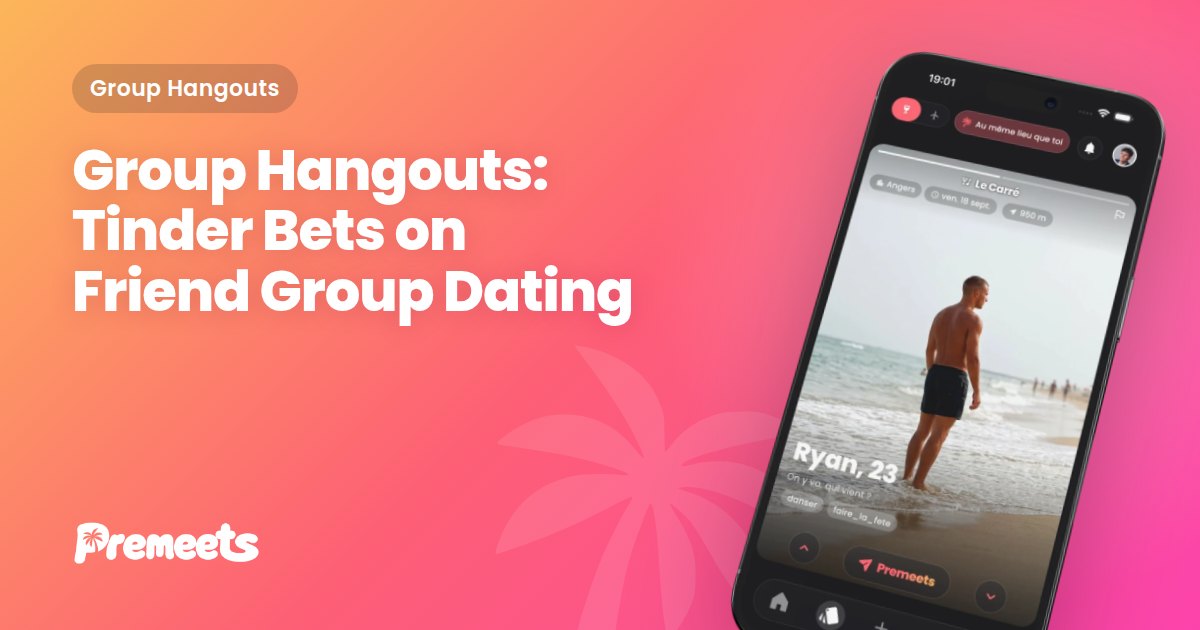
Group Hangouts: Tinder Bets on Friend Group Dating
Tinder rolls out Group Hangouts in the UK, encouraging friend groups to meet up together rather than one-on-one. Here's why group dating is back.
By Mathis Mauprivez
5 min read
Contents
Since 23 November 2026, Tinder has been offering a new feature in the UK called Group Hangouts: groups of three or more friends can match with other groups to plan an outing together, rather than looking for a one-on-one date. It’s another signal, following Tinder Events launched in early November, that even the swipe giant is trying to recreate the logic of friends going out together, in the right place at the right time.
How Group Hangouts works
The idea is simple: one person creates a group, picks an activity and invites at least two friends. Once three members have joined, the group’s profile appears in the discovery feed, visible to other friend groups, according to Verge Magazine.
A few useful details on how it works:
- Groups don’t need to have the same number of members to match with one another.
- As soon as a member from each group expresses mutual interest, a group chat opens automatically so everyone can get to know each other and plan the activity.
- Suggested activities range from drinks between groups to karaoke or mini golf, the aim being to take the pressure off a classic first date.
- Each participant keeps their own account and can leave an individual conversation without leaving their friend group.
Tinder is keen to stress that the tool is still designed for dating, not meant to become a general friend making platform, Verge Magazine notes.
Numbers that confirm the appeal of group dating
Tinder is drawing on tests run in Australia: 40% of Group Hangout invitations were accepted there, and women were 2.2 times more likely to like a group profile than an individual one, reports Verge Magazine. A post shared by Global Dating Insights on LinkedIn adds that in Norway, around 15% of daily active users aged 18 to 22 had already joined a group, and that Double Date, the feature Group Hangouts builds on, has generated 30 million matches since it launched in June 2025.
Mark Kantor, Chief Product Officer at Tinder, sums up the thinking behind the feature:
“Double Date proved something we suspected all along, young singles want their friends in the mix when they’re meeting someone new.”
Turning up with a couple of friends rather than alone is clearly reassuring, and it shows in the engagement numbers: according to Verge Magazine, Double Date matches exchange 35% more messages than standard matches, and 90% of people using this feature are under 30.
A wider shift across the industry
Group Hangouts isn’t an isolated case. That same week, Bumble launched a campaign in India called Bee Line with Janhvi Kapoor, Manika Batra and Reble, leaning into a more community minded take on dating, according to Campaign India. Meanwhile, Hinge is running a campaign that literally invites users to delete the app once they’ve found the right person, documented by MediaBrief, a sign that part of the industry now accepts a dating app’s job is to push people towards meeting IRL rather than holding their attention at all costs.
Kevin Leighton, who follows the dating app industry closely, notes that these moves aren’t all heading in the same direction, but they share a common goal:
“Perhaps the next stage of dating isn’t about every app becoming a community platform.”
In other words, the question isn’t whether dating apps should become social anymore, it’s where social connection creates the most value: inside the app, outside it, or somewhere in between.
Why group dating works better
This return to the group isn’t a marketing fluke. According to the Ined’s 2023 Envie survey, cited by Moderne Love on LinkedIn, only 11% of 18 to 29 year olds in a relationship met their partner on a dating app, even within the generation that grew up with them. People still mostly meet through friends, communities and shared occasions, with the app often just tagging along with what’s already happening elsewhere.
That explains why turning up with company, in numbers, changes things so much: the pressure of a one on one disappears, the conversation has a natural starting point (the activity, the venue, the moment), and if one individual spark doesn’t happen, it doesn’t stop the group outing from going well. This is exactly what Tinder is trying to artificially rebuild with Group Hangouts: bringing context, place and timing back into an experience that, until now, relied mostly on standalone profiles.
What this means for Premeets
At Premeets, this logic isn’t a feature bolted onto an existing swipe system, it’s the starting point of the app. You say where you’re going and when, whether that’s a bar tonight, a festival this weekend or an upcoming trip, and Premeets shows you who else has planned the same place at the same time, with the venue, neighbourhood and distance displayed before you even look at a profile.
This approach happens to serve exactly what Tinder is trying to recreate with Group Hangouts: meeting people in numbers rather than being pushed into a forced one on one. On Premeets, that looks like:
- You can look to grow an existing group of friends for a night out, not just build one from scratch.
- Mutual filters (age, gender, dates, activities) apply right from the search, not after the fact in a chat.
- Messages are sorted by type of plan (friends, nights out, trips), which helps when organising an evening or figuring out who’ll be at your hotel or campsite.
- The point isn’t just dating: friendship and nights out get just as much space, which fits the “hangout” spirit far better than a classic date does.
Where Tinder is building a group feature on top of a system designed around individual profiles, Premeets starts directly from the shared place and moment, for friendship just as much as for dating.
In short
Group Hangouts confirms what several industry watchers have been saying for months: meeting people works better when it’s built around a shared context, a place, a moment, an activity, rather than one lone profile facing another. Whether it’s Tinder, Bumble or Hinge, the industry is trying to recreate that dynamic. Premeets has been doing it from day one, for nights out just as much as for friendship.
Sources
This article draws on the following sources.
- TINDER LAUNCHES GROUP HANGOUTS IN THE UK, LETTING FRIENDS MATCH AND MEET OTHER GROUPS - Verge Magazine (Verge Magazine, 23 November 2026)
- Bumble brings Bee Line to India: Janhvi Kapoor, Manika Batra and Reble pick up on modern dating - Campaign India (Dating apps EN, 23 November 2026)
- Inside the Hinge campaign that wants you to delete the app - MediaBrief (Dating apps EN, 23 November 2026)
- Post LinkedIn de Global Dating Insights (LinkedIn)
- Post LinkedIn de Kevin Leighton (LinkedIn)
- Post LinkedIn de Moderne Love - Agence de rencontres (LinkedIn)
Ready to meet people before you arrive?
Read next
Dating apps · Meeting IRL
Tinder Events: Match Group Bets on Place and Timing
Match Group's Q3 2026 results: Tinder Events lifts DAU while Hinge tests a cheaper plan. Premeets looks at this shift toward place and timing.
4 min read
Dating apps · Safety
AI Fake Profiles: Identity Verification Gets Tougher
Tinder and Hinge are tightening identity checks as AI-generated fake profiles spread, but Gen Z remains wary of these apps. Here's what's changing.
4 min read