
- Dating apps
- Safety
- Artificial intelligence
- Meeting IRL
AI Fake Profiles: Identity Verification Gets Tougher
Tinder and Hinge are tightening identity checks as AI-generated fake profiles spread, but Gen Z remains wary of these apps. Here's what's changing.
By Mathis Mauprivez
4 min read
Contents
Over the past few days, dating app news has focused almost exclusively on one topic: identity verification, as AI-generated fake profiles continue to multiply. Tinder and Hinge have announced new measures in India, Match Group has partnered with an Indian cybercrime unit, and a new survey highlights Gen Z’s persistent wariness of these AI-powered apps. It’s a paradox worth examining.
Tinder and Hinge tighten access in India
According to Rediff, Match Group has introduced mandatory biometric verification at sign-up on Tinder and Hinge, requiring a video selfie from every new user. The stated aim: to detect whether the person behind a profile is real or AI-generated, and to spot faces that reappear under multiple identities, often linked to criminal networks.
Yoel Roth, senior vice-president and head of trust and safety at Match Group, explains that this check allows the whole user base to be scanned for duplicates:
“There’s a limited number of people running these scams. If we see the same face signing up repeatedly, we can remove them for good.” (Yoel Roth, quoted by Rediff)
According to the same source, this initial analysis has already cut the number of malicious accounts on Tinder and Hinge by 40%. Other measures rolled out specifically for India include:
- blocking profile screenshots, first on Hinge and now extended to Tinder,
- the ability to block phone contacts so friends and family can’t see your profile,
- mandatory biometric verification and video selfies at sign-up,
- an annual investment of roughly $125 million in safety, according to Match Group.
A partnership against romance scams
Also according to Rediff and confirmed by Campaign India, Match Group has partnered with the Indian Cybercrime Coordination Centre (I4C), under the Ministry of Home Affairs, to launch a romance scam awareness campaign. It covers five areas: conversations moving quickly off-platform, verifying identities, suspicious investment advice, requests for money, and building trust before any financial request.
Nishant Kumar, director of I4C, sums up the spirit of the collaboration:
“Trust must go hand in hand with caution online.” (Nishant Kumar, quoted by Campaign India)
This campaign builds on tools already in place at Tinder (Face Check, Photo Verification, the “Share My Date” feature) and Hinge (Face Check, a sign-up block list, screenshot protection), still according to Campaign India.
AI is industrialising fake accounts
Why the sudden push now? Because the tools capable of mass-generating fake accounts are advancing just as fast as the defences built to catch them. IT조선 notes that Tinder now has to contend with Muse, Meta’s AI tool capable of creating accounts automatically, which is precisely what’s pushing the platform to strengthen its methods for verifying real users. The race between fake profile generators and fake profile detectors is, in short, only just getting started.
Gen Z isn’t convinced
This tightening of controls comes just as a new survey tempers the enthusiasm around AI on dating apps. According to The Star, young Gen Z users remain sceptical of AI-powered features, despite platforms’ efforts to reassure them.
That wariness makes sense: the more apps lean on AI to write messages or generate profiles, the more the question “is this really a person” becomes central to every conversation. Identity verification partly answers that doubt, but not entirely.
Is verifying after the fact really enough?
News18 asks the question head on in an explainer: are Tinder, Bumble and Hinge really doing enough to keep users safe? The answer comes down to a simple observation. Even with a video selfie and biometric verification at sign-up, the underlying model has barely changed in years: a profile is created first, essentially out of thin air with no real anchor, and its authenticity is checked afterwards.
A patient scammer therefore still has plenty of time to try their luck past the filters, since nothing in this system requires anyone to prove they’ll actually be where they claim to be going.
The Premeets approach: starting from a real plan, not a profile
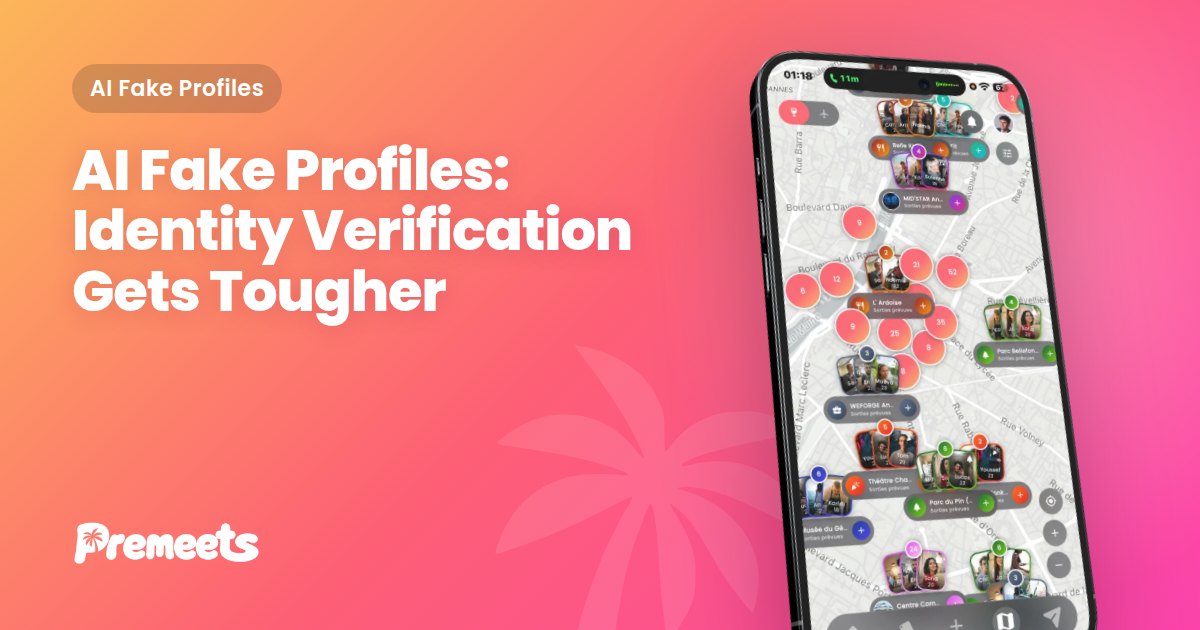
On Premeets, the logic is reversed. Instead of displaying a floating profile detached from any context, you state where and when you’re going, a bar tonight, a festival this weekend, a hotel, a campsite, an upcoming trip. Premeets then shows the people who’ve planned the same place at the same time, along with the venue, the neighbourhood and the distance.
This starting point changes everything for a fake profile. Generating a photo and a bio with AI costs next to nothing. But inventing a credible travel plan, with a specific date, a precise location and an expected presence on site, makes the whole operation far less profitable for anyone looking to scam at scale. Context acts as a first filter, even before the profile itself.
Premeets also adds mutual filters (age, gender, dates, activities), messaging organised by plan (friends, nights out, trips) to prepare the meet-up before arriving, and responsive reporting and blocking tools. The app is built as much for friendship and nights out as for dating: heading to a festival solo, growing a group, or knowing who else is on your campsite.
In short
Tighter identity verification at Tinder and Hinge responds to a real threat, AI-generated fake profiles and romance scam networks. But Gen Z’s persistent wariness shows that verifying a profile after the fact isn’t always enough to restore trust. Starting from a real, verifiable intention, a place, a date, a shared plan, is another way of tackling the problem, upstream rather than downstream.
Sources
This article draws on the following sources.
- Tinder, Hinge Step Up Safety Measures For Indian Users - Rediff (Rediff, 30 October 2026)
- Match Group partners with I4C to tackle romance scams - Campaign India (Campaign India, 29 October 2026)
- Swipe Right, Get Scammed? Are Tinder, Bumble And Hinge Really Doing Enough To Keep You Safe? - News18 (News18, 29 October 2026)
- How Tinder Verifies Real Users as Meta's Muse AI Creates Accounts - IT조선 (IT조선, 29 October 2026)
- Gen Z is still sceptical of AI-infused dating apps, new survey finds - The Star (The Star, 29 October 2026)
Ready to meet people before you arrive?
Read next
Dating apps · Meeting IRL
Meeting IRL: Even Tinder's Own Boss Admits It's the Goal
Tinder's CEO now admits that singletons want to meet in person, just as a mass exodus hits swipe culture. Premeets was built for exactly this shift.
4 min read
Dating apps · IRL dating
Bumble at $1 billion: has the swipe hit rock bottom?
Bumble is in advanced talks to leave the stock market for $1 billion, down from $14 billion in 2021: what this crash reveals about the end of the swipe.
5 min read